★★★★★
★★★★★
Verified Buyer
Everything that I ordered 'till now was perfect.
Product Usage: This product is intended for research purposes only.
All product information available on this website is for educational purposes only. Any form of bodily introduction into humans or animals is strictly prohibited by law. This product should only be handled by licensed and qualified professionals. It is not a drug, food, or cosmetic, and must not be misbranded, misused, or mislabeled as such.
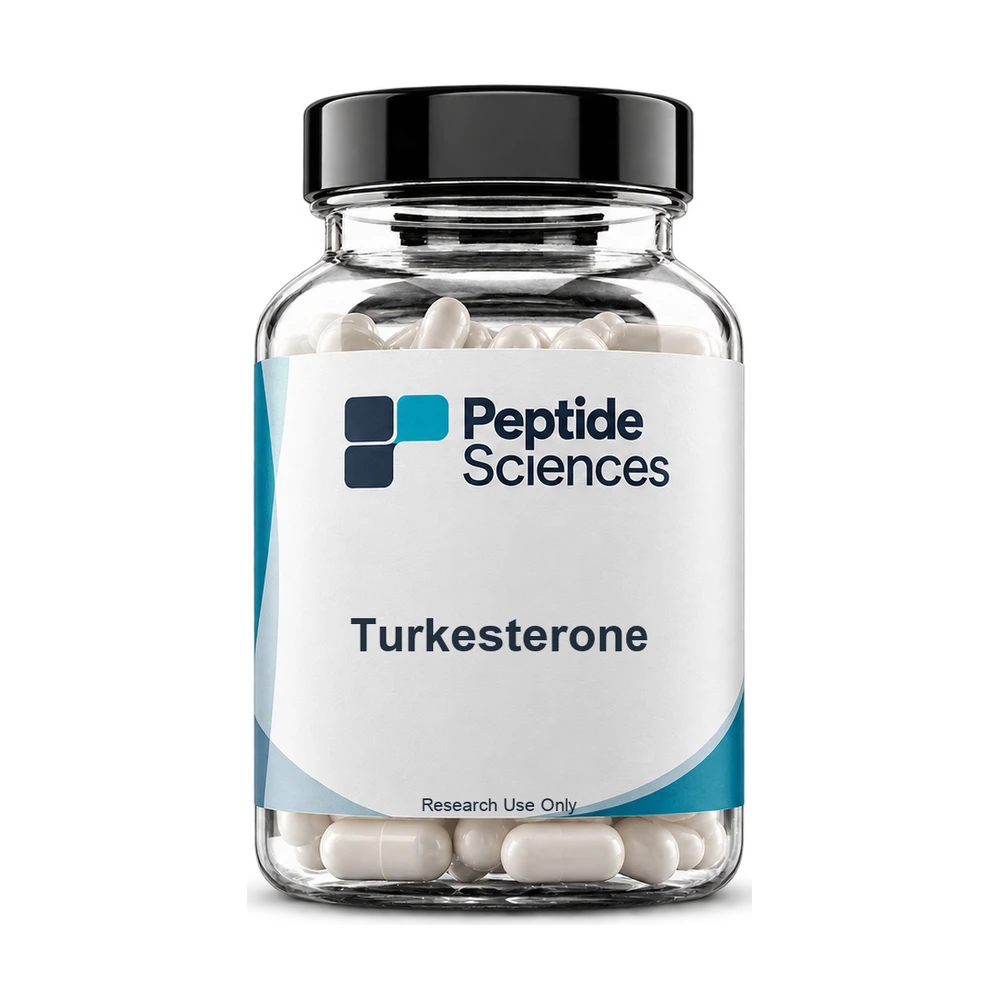
Turkesterone is a naturally occurring ecdysteroid compound. It is isolated from several plant species. This includes Ajuga turkestanica. Ecdysteroids are steroid-like molecules that share structural similarities with insect molting hormones. All of them are commonly studied in biochemical and phytochemical research environments.
During our packaging transition, you may receive products with either our previous or updated label. Rest assured, the formulation, purity and quality remain exactly the same as per our standards.
-25% on everything – until October 31
25% off regular prices, replacing other product sales. Only the crypto payment discount can be combined.
Turkesterone is a naturally occurring ecdysteroid compound. It is isolated from several plant species. This includes Ajuga turkestanica. Ecdysteroids are steroid-like molecules that share structural similarities with insect molting hormones. All of them are commonly studied in biochemical and phytochemical research environments.
In experimental research, Turkesterone is investigated as a phytoecdysteroid molecule. This is the one that is capable of interacting with ecdysteroid receptor systems and related signaling pathways in controlled laboratory models. Studies of this compound often focus on:
Turkesterone is supplied strictly as a research material intended for laboratory investigation.
Turkesterone has been investigated in experimental assays. This is done for its ability to interact with ecdysteroid receptor complexes (ECR). In vitro studies have shown that the compound may bind to receptor complexes. These are the ones involved in steroid-like signaling pathways within certain biological systems.
As a phytoecdysteroid, Turkesterone possesses a cyclopentaphenanthrene steroid-like ring structure. It also has multiple hydroxyl groups that may participate in hydrogen-bond interactions with receptor sites in biochemical assays.
Researchers analyze these structural characteristics to study how ecdysteroid molecules affect:
Because of its steroid-like scaffold and multiple functional groups, Turkesterone is frequently examined in structure-activity relationship (SAR) investigations. These studies evaluate how modifications to ecdysteroid molecules influence receptor interaction, molecular stability, and ligand binding behavior.
Within controlled laboratory environments, Turkesterone may be utilized for investigations involving:
All applications are limited strictly to analytical and experimental research environments.
Todorova, V., Ivanova, S., Chakarov, D., Kraev, K., & Ivanov, K. (2024). Ecdysterone and Turkesterone—Compounds with Prominent Potential in Sport and Healthy Nutrition. Nutrients, 16(9), 1382. https://doi.org/10.3390/nu16091382
Guibout, L., Mamadalieva, N., Balducci, C., Girault, J., & Lafont, R. (2015). The minor ecdysteroids from Ajuga turkestanica. Phytochemical Analysis, 26(5), 293-300. https://doi.org/10.1002/pca.2563/
| Compound Name | Turkesterone |
|---|---|
| CAS Number | 41451-87-0 |
| Molecular Formula | C27H44O8 |
| Molecular Weight | 496.63 g/mol |
| Chemical Class | Phytoecdysteroid |
| Research Category | Natural steroid-like research compound |
| PubChem CID | 14376672 |
| Source | Plant-derived ecdysteroid (e.g., Ajuga turkestanica) |
Everything that I ordered 'till now was perfect.
Great. I've purchased numerous times.
Very satisfied with my purchase. The product arrived on time and in perfect condition.
Our research results have been outstanding. Great experience with the customer service and purity is outstanding. Highly satisfy and will return.
Outstanding experience with the super fast shipping, purity is outstanding. The experimental results were exceptional. Highly recommend this vendor.
Our research results are completely exceeding expectations. Truly happy with the customer service and the product is of excellent quality. A trustworthy supplier.